How white-label Webflow development works for agencies: pricing and margin, NDA and file ownership, workspaces, client billing and time zones.
Cover · a finished client build
11
min read
White-label Webflow development means a developer builds your client's site inside your agency's Webflow Workspace, under your name, and your client deals only with you. You pay per project or for a block of monthly hours, and the files are yours once you've paid. I do this for agencies from New Delhi, and two things decide whether it works for you: the margin left after my price, and Webflow's billing rules for agency-held sites, which change at renewal from 16 November 2026.
What white-label Webflow development means in practice
In a white-label project, I build in your Webflow Workspace from your designs and brief. Nothing in the build points to me: no diyo branding in the code, the class names or the staging site. I sign your NDA before you send any files, and the site and its files become yours when you pay. Your client sees your agency's work.
Here is what that looks like day to day:
You add me to your Workspace, and the site lives there from the first day. There is no export or rebuild at the end.
The staging site runs on your webflow.io subdomain, named for your project.
I build on Finsweet's Client-First, so class names describe structure (section_hero, padding-global) and any developer on your team can read them.
You review everything on staging before your client sees it, and you decide what goes forward.
How white-label pricing works: per project or monthly hours
I offer two models. Per project, an agency pays 80% of the price I'd quote a direct client for the same scope. By the hour, agencies buy a monthly block: $600 for 20 hours, $1,120 for 40 hours or $2,080 for 80 hours. Hour blocks start within 2 to 3 business days, and unused hours roll over for 30 days.
diyo.studio white-label prices as of October 2026, in USD. The per-project example is a 10-page site with a blog, built from a ready Figma file.
Model
Price
Works out at
Suits
Per project
$2,200 to $2,900, 2 to 4 weeks
80% of the $2,700 to $3,600 direct price
A defined build with a fixed design
20 hours a month
$600
$30 an hour
Edits and small pages across client sites
40 hours a month
$1,120
$28 an hour
A steady stream of builds and changes
80 hours a month
$2,080
$26 an hour
Close to a part-time Webflow developer
What that leaves you in margin
Margin is the number to check before anything else. A February 2026 ViralChilly guide tells agencies to "target 50-70% gross margins" on white-label resale. Take the middle of my per-project example, $2,400. To keep 50%, you need to sell that site for $4,800 or more. To keep 70%, about $8,000.
Whether you clear that depends on what you charge. The BRIX Templates cost guide (updated 21 May 2026) puts a 1 to 10 page site at $3,600 to $9,000 from a small studio and $7,200 to $18,000 from a mid-level agency. A mid-level agency pricing inside that band keeps half or more. A small studio selling the same site for $4,000 keeps about 40%, which is thin once your own project management is counted.
I'm not the cheapest option. ViralChilly quotes offshore developers at $15 to $30 an hour, and Upwork gives a $31 median for Webflow developers (as of October 2026). My hour blocks work out at $26 to $30 an hour, the top of that offshore range and just under the Upwork median. Against ViralChilly's retainer bands ($500 to $1,200 for 10 to 20 hours, $1,200 to $2,500 for 20 to 40), my 20-hour block sits inside the first band and my 40-hour block just under the second. If you want to compare with a direct build, see what a Webflow build costs.
Whose Webflow Workspace should the site live in?
The site should live in your agency's Workspace during the build. That keeps the client relationship, the staging site and the billing decision with you. Webflow's Freelancer Workspace costs $16 a month and the Agency Workspace $35 a month, both billed yearly, according to webflow.com/pricing as of 13 October 2026.
The two plans differ in ways that matter for white-label work:
Freelancer gives you 10 staging sites and 1 free client seat per site.
Agency gives you unlimited staging sites, 3 free client seats per site, site-level roles and site password protection.
Both include client payments, which the next section covers.
Password protection is the feature I'd pay for. It keeps an unfinished staging site private while you share the link with your own team.
Check one cost before you add any developer. Webflow's seats and roles overview (updated 5 Oct 2026) puts the Designer role on a Full seat. Each Workspace plan includes one Full seat, and extra Full seats cost $39 a month billed yearly. Content editors can use a Limited seat at $15 a month or a free client seat.
Handing billing to the client: client payments or a site transfer
When the build is done, you have two ways to stop paying for the client's hosting. Client payments keeps the site in your Workspace while the client pays for its Site plan. A transfer moves the site, its plan and its domain into the client's own Workspace. Pick client payments if you'll keep maintaining the site, and a transfer if the client is taking it in-house.
Client payments is only available on Freelancer and Agency Workspace plans.
The client pays for Site plans, bandwidth and add-ons. You keep control of the site.
Only one client can be attached to a site, and a Workspace can have at most ten pending payment requests.
The client's Webflow account must not already be a member of your Workspace.
The client gets the Content editor role by default, which you can change under Site access.
Site transfer
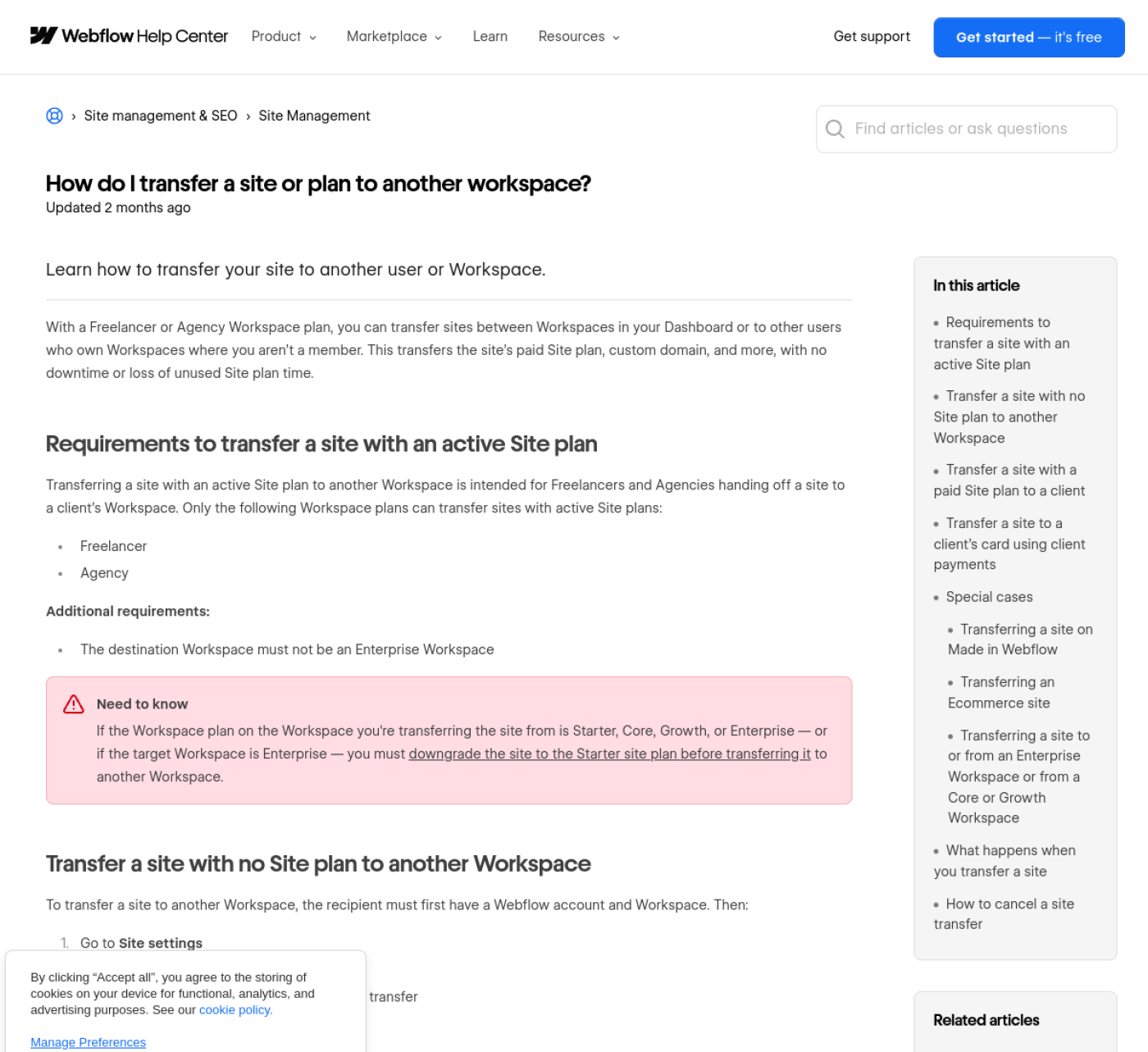
A transfer "transfers the site's paid Site plan, custom domain, and more, with no downtime or loss of unused Site plan time," according to Webflow's transfer article (updated 1 Aug 2026). After that, you can't edit the site unless the client adds you to their Workspace.
Only Freelancer and Agency Workspaces can transfer sites with active Site plans. Webflow Help Center, captured 13 Oct 2026.
Some settings don't travel with the site. Webflow resets account- and client-specific configuration, including form notification settings, reCAPTCHA keys, Adobe Fonts API keys and comments. Shared Libraries are uninstalled, and any components, variables and assets in use are copied into the site. Connected apps need to be authorized again.
WarningAfter a transfer, submit every form once and confirm the notification email arrives. Form notification settings reset on transfer, so leads can go unread for days before anyone notices.
Ecommerce sites are different. Their Site plans don't transfer, so the new owner has to add an Ecommerce plan and turn checkout back on.
What changes for agency client sites from 16 November 2026
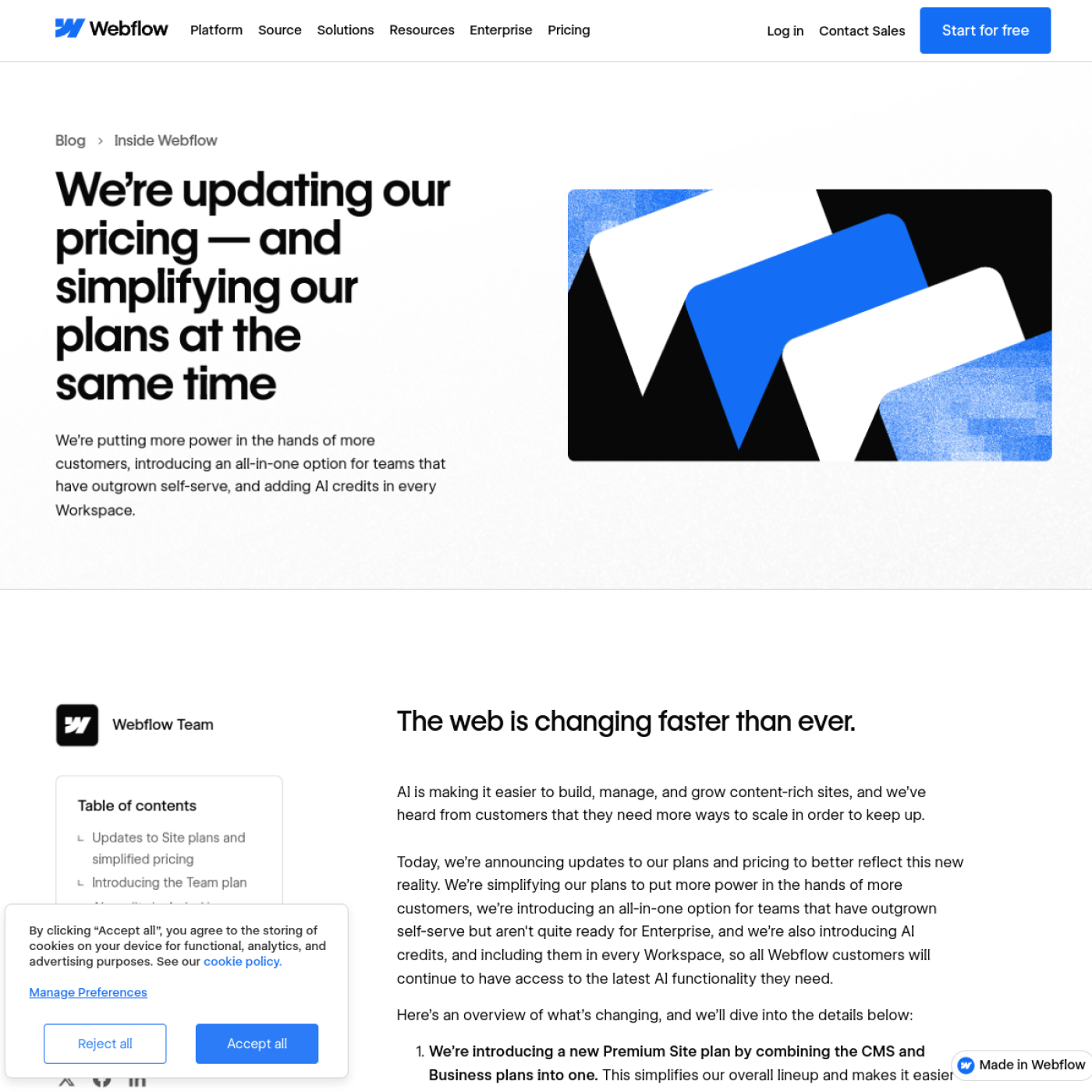
Webflow's 2026 plan changes reach agency-held sites last. In Webflow's words, "for existing sites in Freelancer or Agency Workspaces OR sites on legacy pricing, changes take effect on your next renewal or billable change on or after November 16, 2026" (Webflow blog, updated 20 Jul 2026).
What changes at that renewal, per Webflow's pricing help article (updated 31 Aug 2026):
CMS sites move to the new Premium plan at $25 a month billed yearly or $39 monthly. That is an increase, though the item limit rises from 2,000 to 20,000.
Business sites also move to Premium at the same price, which is a decrease, and their item limit rises from 10,000 to 20,000.
Basic rises to $15 a month billed yearly or $25 monthly, still without a CMS.
Webflow's announcement of the 2026 plan changes. Webflow blog, captured 13 Oct 2026.
If you resell hosting to clients at a fixed markup, the CMS-plan sites are the ones to look at first. Tell those clients what their next invoice will be before Webflow does.
Editor white-labeling ended in August
Webflow's feature sunsets page says "the legacy Editor and whitelabeling will no longer be available starting August 4, 2026." Your clients now edit through seats and roles inside Webflow, so you can no longer put your agency's branding on the editing screen. Update your training docs and any proposal that promises a branded editor.
White-label in this post means unbranded subcontracting. That still works as it did. What Webflow removed is the option to brand its editing screen.
NDA, IP and file ownership
My terms are short: I sign an NDA before you send files, I keep diyo branding out of the code, the class names and staging, and the site and its files are yours once you've paid. Read any partner's terms for three more points: who they may contact, how long confidentiality lasts, and when ownership moves to you.
Confidentiality covers client names, project details and "the existence and nature of the white label relationship," commonly for three to five years after the work ends.
Non-solicitation of your clients and staff, "commonly 12 to 24 months."
Either side can end the relationship on 30 days' written notice, with about two weeks of paid overlap to hand over.
KrishaWeb also argues ownership should pass "at creation, not at payment." My terms pass ownership on payment, which protects me if an invoice goes unpaid. If your contract with your client promises ownership at creation, raise it before we start so the two contracts match.
Working across time zones from New Delhi
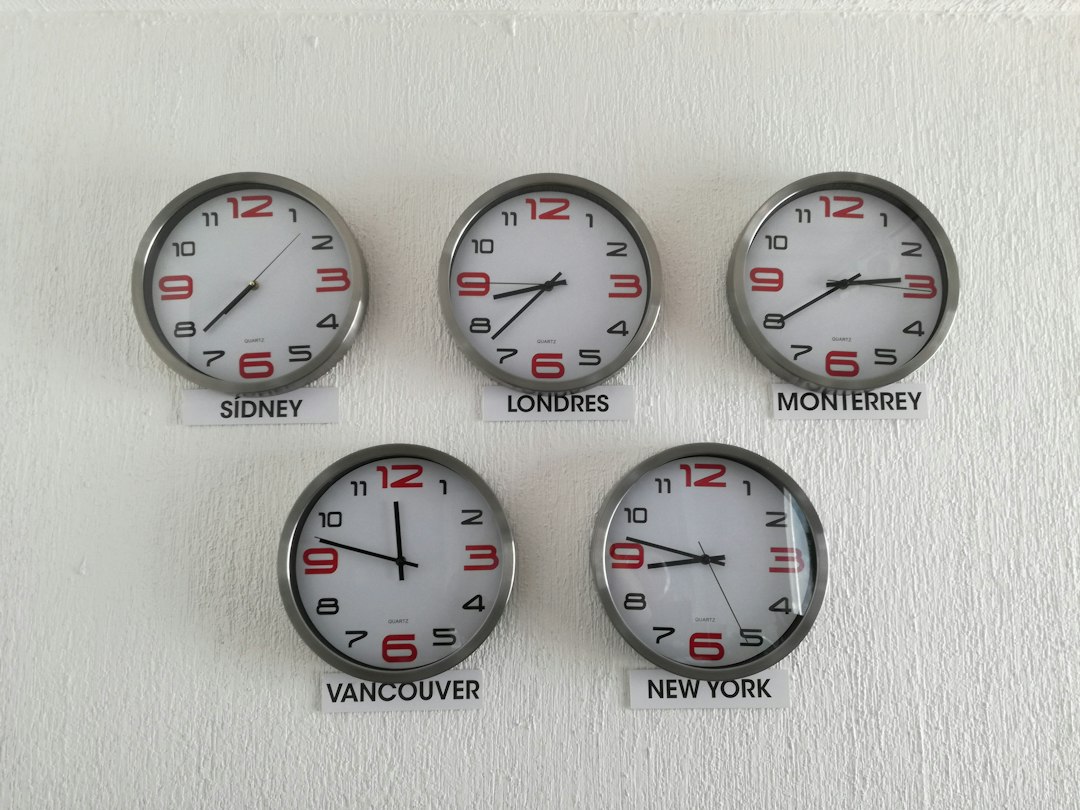
India Standard Time is UTC+5:30 all year, with no daylight saving. That puts New Delhi 9.5 to 10.5 hours ahead of New York and 4.5 to 5.5 hours ahead of London. Feedback a US team sends at the end of its day arrives before the Indian working day starts. A full Indian business day passes before New York's next morning.
Your working day in India Standard Time (UTC+5:30). Summer means daylight saving where you are; US and UK clocks go back in late October and early November 2026.
Your city
Your 5 pm is, in New Delhi
Your next 9 am is, in New Delhi
New York
2:30 am (summer) or 3:30 am (winter), next day
6:30 pm (summer) or 7:30 pm (winter)
San Francisco
5:30 am (summer) or 6:30 am (winter), next day
9:30 pm (summer) or 10:30 pm (winter)
London
9:30 pm (summer) or 10:30 pm (winter)
1:30 pm (summer) or 2:30 pm (winter)
Sydney
11:30 am (AEDT) or 12:30 pm (AEST), same day
3:30 am (AEDT) or 4:30 am (AEST)
The overnight loop works best for US agencies. UK agencies get less of it and more shared daytime instead: a London morning is the Indian afternoon, which suits live calls. Sydney is ahead of India, so the loop runs the other way and a Sydney afternoon is the Indian morning.
The loop has one weakness. A question I send in my day may not get its answer until your next morning, and an open question can cost a full day. Send feedback as one complete list, with screenshots or a short screen recording for anything visual. I reply within one business day.
Questions to ask any white-label Webflow partner
Ask these before you sign with anyone, including me. A good partner answers each in a sentence or two without needing to check.
1. Can I see live Webflow sites you built, and run PageSpeed Insights on them myself?
2. Will you build in our Workspace? Which seat and role do you need?
3. Which class system do you use? Could our own developer take over mid-project?
4. Will you sign our NDA before we share files?
5. Will you agree never to contact our client, and to a non-solicit? For how long?
6. When does ownership of the site and files pass to us: at creation or on payment?
7. Who else touches the work? Do you subcontract any of it?
8. How many projects do you run at the same time?
9. How fast do you reply, and what happens when you have a question overnight?
10. What does a round of changes include, and how many are in the price?
11. How much do you take up front, and when are the other payments due?
12. What happens to our project if you are ill or unavailable for a week?
13. What notice do you need to end a monthly retainer?
For reference, my answers to some of these are fixed: I take on two projects at a time, two rounds of changes are included, and I never take more than 50% up front. Quotes and invoices are in USD.
When an agency should not outsource Webflow work
Outsourcing is the wrong call when it costs you the margin, the quality control or the client relationship it was meant to protect. Keep the work in-house, or find a different partner, in these cases:
Your build quality is what clients buy from you. Handing it out means selling someone else's craft under your name.
Your price leaves under about 50% after the partner's fee. On my per-project example, that's a client price under $4,800.
No one at your agency can review Webflow work. Someone has to check the build on staging before the client sees it, or every mistake reaches your client with your name on it.
Your client expects live working sessions during US Pacific hours. A 9 am start in San Francisco is 9:30 pm or later in New Delhi, so a partner in India is a poor fit for that.
Your client contract bars subcontracting, or requires the work to be done in a certain country.
The job is a one-hour fix. Writing the brief and reviewing the change can take longer than doing it yourself.
I build Webflow sites for agencies in your own Workspace, under your NDA, per project at 80% of my direct price or in monthly hour blocks.
Before your first client renewal on or after 16 November, list every site in your Workspace with its Site plan and renewal date, and mark the CMS-plan sites. If you'd like to talk through a white-label setup, book a 30-minute call on Zoom.
I'm Chirag Singh. I design and build Webflow sites at diyo.studio in New Delhi, and I write about what comes up on client builds.
Choosing a Webflow User Accounts alternative in 2026: Memberstack vs Outseta prices, Zapier, Make or n8n for old Logic flows, and a migration checklist.
Webflow maintenance in 2026: what Webflow hosting covers, what still needs a person, a monthly checklist, care plan prices and what a plan should include.
Webflow site speed in 2026: Core Web Vitals thresholds, field vs lab data, and the Webflow fixes for images, fonts, scripts and animation, in priority order.
How to hire a Webflow developer in India from the US, UK, UAE or Australia: time-zone overlap, payments and GST, IP contracts, data protection and prices.
Webflow vs Wix vs Squarespace in 2026: three-year costs, design control, CMS limits, SEO, speed and lock-in, and which one fits your team and growth plans.
Webflow AEO in 2026: the robots.txt rules, page structure, schema and third-party mentions that get a Webflow site cited by ChatGPT, Perplexity and Google.
Is Webflow good for SEO? Yes, for most marketing sites. What Webflow handles natively, its real limits as of October 2026, and who should pick another platform.
Webflow developer rates and cost in 2026 for the US, UK, UAE, Australia and India, from Upwork, Clutch and Webflow's partner directory, plus quote tips.
Framer vs Webflow in late 2026: current pricing, CMS limits, editing, SEO, languages and migration, with a plain guide to who should pick each platform.
Webflow pricing as of October 2026: Site and Workspace plans, seats, yearly billing, bandwidth, add-ons, ecommerce and what changes at your next renewal.
A build-ready Figma file for Webflow: auto layout, variables, layer names, components, breakpoints and CMS states, checked against Webflow's plugin rules.